Cancer care is becoming more efficient – Better outcomes without escalating costs (Guest blog)
12.03.26
Europe is achieving better cancer outcomes without cancer overwhelming health budgets. In fact, cancer care is delivering increasing value for money.
Cancer places a substantial burden on European societies. It accounts for 23% of all deaths and around 17% of disability-adjusted life years (DALYs), making it one of the most significant causes of the overall disease burden. Against this backdrop, cancer is often thought of as a growing financial threat to health systems. Yet the Comparator Report on Cancer in Europe 2025 by the Swedish Institute for Health Economics (IHE) commissioned by the EFPIA Oncology Platform tells a more nuanced and more encouraging story.
Europe is achieving better cancer outcomes without cancer overwhelming health budgets. In fact, cancer care is delivering increasing value for money.
Cancer spending in context
One of the most striking findings of the report is how modest cancer spending is in relative terms. Despite its high disease burden, cancer accounts for only 6–7% of total health expenditure across Europe — a share that has remained remarkably stable for three decades. Put differently, around 93% of health spending goes to other conditions.
Given the scale of cancer’s impact, one might expect a much larger share of health budgets to be devoted to it. Instead, Europe has managed to improve survival outcomes substantially without cancer consuming a disproportionate share of healthcare resources. This alone challenges the perception that cancer care is financially unsustainable.
Direct costs up, indirect costs down
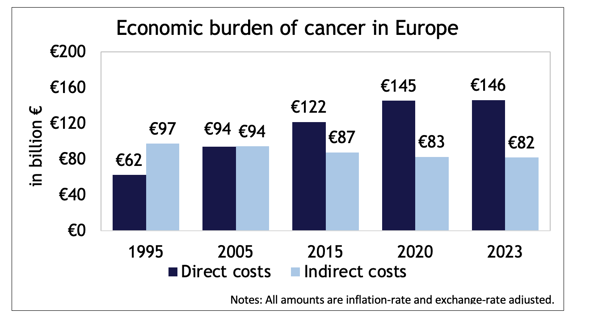
From 1995 to 2023, healthcare spending on cancer (called direct costs) more than doubled from €62 billion to €146 billion across Europe. At first glance, this appears alarming. But focusing on healthcare costs alone tells only part of the story.
Cancer also generates large indirect costs outside the health system – through sick leave, early retirement, and premature death – that all represent productivity losses to the economy. These costs used to be larger than the direct costs, yet they are not visible in health budgets. Their development over time runs counter to the one of the direct costs, with a drop from €97 billion in 1995 to €82 billion 2023.
The decline in indirect costs is not accidental. It is the direct consequence of better cancer outcomes. More effective treatments mean fewer people dying during working age, fewer years of productivity lost, and more people able to remain in or return to work.
When these indirect costs are included, a different picture emerges. While total economic costs of cancer increased by about 43%, this growth closely mirrors the 60% increase in cancer incidence over the same period. As a result, the economic burden per new cancer patient has remained remarkably stable at around €69,000-79,000 per patient since 1995.
This stability reflects a crucial trade-off. Europe has accomplished a shift of costs into the healthcare system – where they are very visible to decision-makers – and reduced costs borne by society through lost productivity.
Graph based on Figure 31 in the Comparator Report
Changing composition of cancer spending
Another important shift has occurred in how money is spent within cancer care. The structure of health expenditure has changed significantly, with less spending on inpatient hospital care and more on outpatient care and medicines.
Shorter hospital stays, improved management of side effects, quicker recovery, and fewer recurrences/relapses of the disease have improved efficiency. New cancer medicines – including oral treatments taken at home and subcutaneous formulations administered in minutes – have replaced longer intravenous infusions in many settings. Paradoxically, spending more on medicines has enabled savings elsewhere in the system.
Spending levels vary widely and correlate with better outcomes
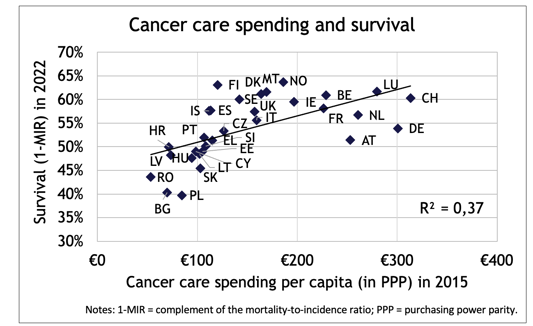
Despite some convergence, cancer spending still varied nearly three-fold across European countries in 2023. Health spending per capita on cancer care remains below €150 (PPP-adjusted) in countries such as Bulgaria, Croatia, Hungary, Latvia, and Romania, while exceeding €400 in Germany and Switzerland.
The report shows that higher cancer care spending is generally associated with higher survival, though efficiency matters. Gains in survival per additional euro spent diminish beyond a certain point. This highlights the importance of not only spending more, but spending wisely.
Graph based on Figure 35 in the Comparator Report
Investment that has paid off and still matters
The overarching message is clear: investment in cancer care across Europe has paid off. From 1995 to 2023, increased healthcare spending was not money spent without results. Survival rates have improved substantially in every country with available data. For Ministries of Health and Finance alike, this is a critical insight.
At the same time, Europe is still far from “beating” cancer. While five-year survival for breast and prostate cancer now approaches 90%, other cancers – notably lung cancer – still have survival rates below 30%. Continued progress will require sustained, efficient investment.
In conclusion, cancer care in Europe is not a story of escalating costs. It is a story of better outcomes, smarter spending, and value delivered – with more still to be achieved.
Key takeaways:
